
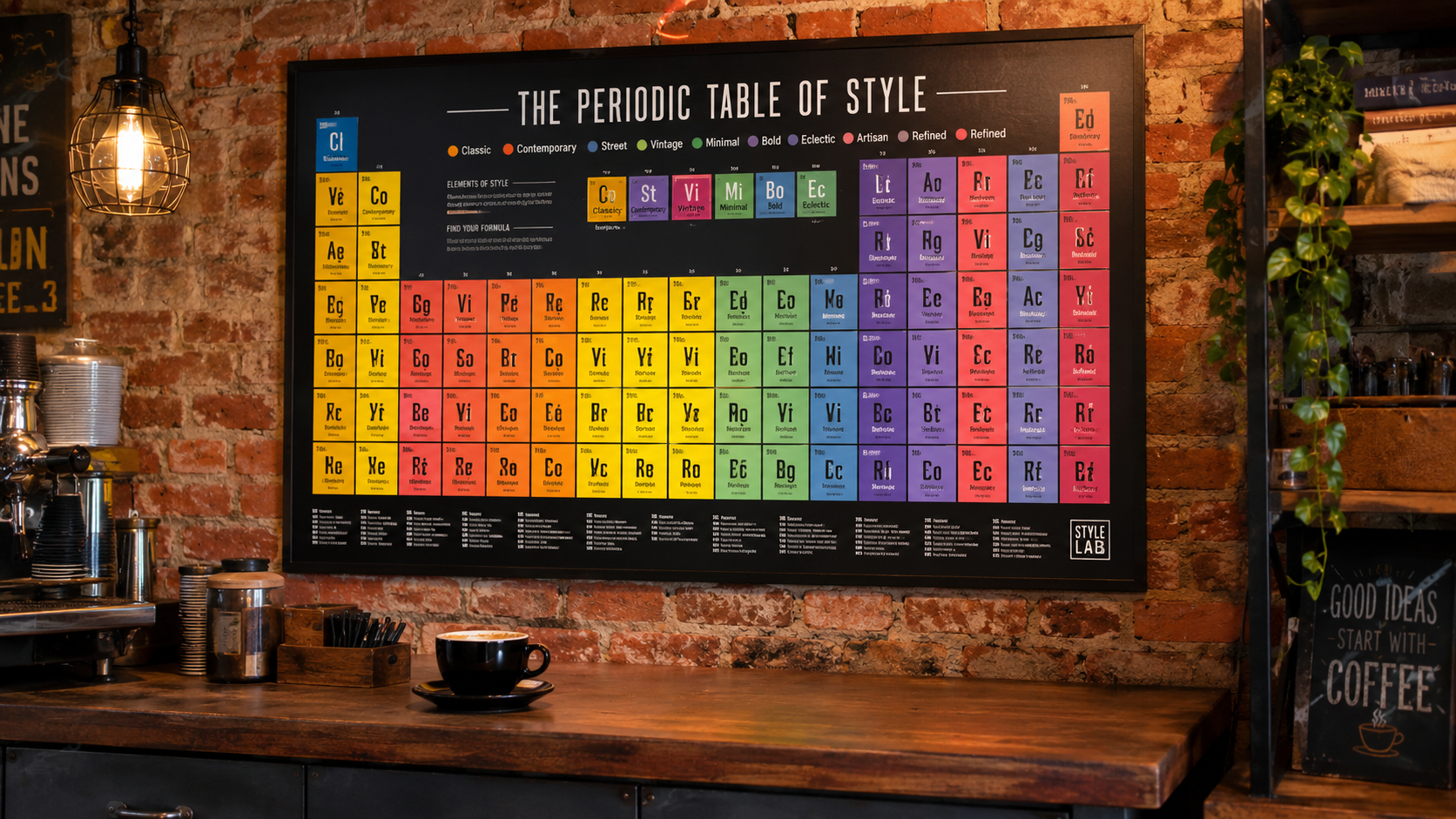
Dmitri Mendeleev probably did not envision his periodic table appearing on tote bags, leggings, and shower curtains when he organized the elements in 1869. But here we are. The periodic table has become one of the most recognizable design motifs in nerd culture, and its journey from chemistry textbook to fashion icon tells us something interesting about the relationship between science and style.
The periodic table works as a design element for the same reason it works as a scientific tool: it is elegant. It takes the overwhelming complexity of matter itself and organizes it into a clean, comprehensible grid. Each element gets a box, a symbol, a number. The whole thing fits on a single page. There is something deeply satisfying about that — a feeling of order imposed on chaos that appeals to both the scientist and the designer.
Elements of Fashion
The elements themselves have always had a connection to fashion, even before anyone knew they were elements. Gold and silver have adorned human bodies for millennia. Copper gives turquoise its distinctive color. Iron oxide provides the red in lipstick. Carbon, in its diamond form, has driven entire economies and inspired countless songs about engagement rings.
But the modern relationship between the periodic table and fashion goes beyond using elements as raw materials. It is about using the table itself — its structure, its symbolism, its visual language — as a design vocabulary. When someone wears a shirt featuring the element symbols for carbon, oxygen, and iron arranged to spell something clever, they are participating in a visual tradition that is simultaneously scientific and creative.
The Chemistry of Color
One of the most fascinating intersections of chemistry and style is color itself. Every pigment, every dye, every colored fabric you have ever worn exists because of chemistry. The deep indigo of your jeans comes from a molecular structure first derived from plants and now synthesized industrially. The vivid red of a designer gown might owe its intensity to cadmium compounds. Even the simple act of choosing what color to wear is, at a molecular level, a chemistry experiment.
Designers who understand this connection — who know that Tyrian purple was once worth more than gold because it required thousands of sea snails to produce — bring a depth to their work that purely aesthetic thinking cannot provide. As IUPAC continues to standardize and expand our understanding of chemical nomenclature, the vocabulary available to scientifically minded designers only grows richer.
Beyond the Novelty
There was a time when periodic table fashion was purely novelty — kitschy prints meant to signal "I am a science person" without much thought to design quality. That era is ending. Contemporary designers are using the periodic table as a starting point for genuinely sophisticated work. Minimalist jewelry featuring individual element symbols. Textiles with patterns inspired by electron orbital diagrams. Accessories that reference specific elements meaningful to the wearer — a biologist wearing osmium, the densest naturally occurring element, or a photographer wearing silver, the element that made film photography possible.
This evolution from novelty to nuance mirrors the broader maturation of nerd fashion. As the audience for science-inspired design has grown, so have the expectations. People want beauty and intelligence in the same garment. They want to feel smart and look good simultaneously, and the best periodic table designs deliver exactly that.
Elemental Identity
Perhaps what makes the periodic table such an enduring design motif is its universality. It does not belong to any country, culture, or era. It is a map of what everything is made of — including us. When you wear the periodic table, you are wearing a reminder that you are made of the same stuff as stars. That the calcium in your bones was forged in a supernova. That you are, quite literally, the universe examining itself.
Mendeleev organized the elements. Fashion gave them style. And somewhere between the chemistry and the couture, something beautiful emerged — a way of wearing our connection to the fundamental nature of reality. Not bad for a chart that started as a classroom tool.